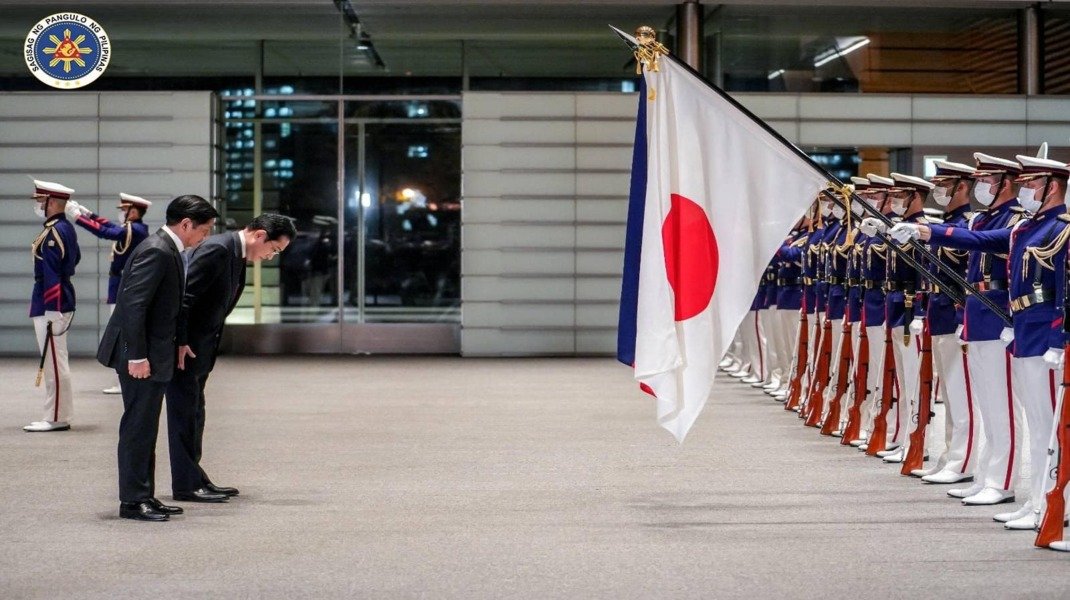
President Ferdinand R. Marcos Jr. left Manila on Tuesday for a four-day state visit to Japan. Accordingly, the Philippines is expected to secure several new agreements aimed at boosting both economic and defense cooperation between the two nations.
The presidential aircraft carrying Marcos departed from Villamor Air Base in Pasay City at exactly 1:36 p.m.
In his departure statement, the President emphasized that this state visit arrives at a pivotal moment. In fact, he noted that the Philippines and Japan are continuing to deepen their strategic partnership despite “increasingly challenging and evolving” regional and global issues.
Furthermore, Marcos explained that this trip represents his first state visit to Japan since his official and working visits to Tokyo and Osaka in 2023 and 2025.
Consequently, it forms a key part of a broader foreign policy agenda. This agenda, he said, aims to forge closer political ties, strengthen defense and security cooperation, and build more enduring economic partnerships with major regional powers. Ultimately, the goal is to advance the interests of the Filipino people while also promoting regional peace, stability, and prosperity.
He added, “This visit seeks to further strengthen the bonds of friendship with a close neighbor—a like-minded and future-oriented partner—and a most reliable ally in times of prosperity and uncertainty, such as today’s ongoing oil crisis.”
Interestingly, the state visit coincides with this year’s commemoration of the normalization of diplomatic relations between Manila and Tokyo. For context, these ties were formally established on July 23, 1956.
During the trip, Marcos is scheduled to meet Japanese Prime Minister Sanae Takaichi. As a result, the two leaders will hold comprehensive discussions on strengthening economic and security coordination. Moreover, they are expected to advance shared commitments to regional and global peace and prosperity.
In addition, both leaders are likely to witness the signing and exchange of key agreements on trade and investment. Likewise, new initiatives in security and maritime cooperation are also expected to be announced.
According to Marcos, “I believe we can further expand our security, economic, and development cooperation in order to enhance our national defense posture and to uplift the standard of living of Filipinos across the country.”
To achieve this, the Philippines will advance discussions on several fronts. These include agriculture, energy, decarbonization, maritime security, trade and investment, infrastructure, defense, space technology, and Mindanao development.
Meanwhile, the country’s growing partnership with Japan continues to support key infrastructure projects under the Build Better More Program. These include major rail and highway developments, as well as ongoing transportation system modernization efforts.
Marcos also reflected, “Indeed, the ties that bind the Philippines and Japan have become ever stronger over the decades. Guided by the transformative spirit within our peoples and driven by the common desire for development persistently pursued by our forebears, our relationship continues to flourish.”
He further stated, “During this trip, I hope to harness the positive trajectory of our relations with Japan in all of our enriching engagements. This administration is keen on working closely with Japan to bring our Strengthened Strategic Partnership to even greater heights.”
For the record, Japan is the Philippines’ first and oldest strategic partner. It remains one of the country’s strongest economic and development allies. Moreover, Japan was the first nation to sign a bilateral free trade agreement with Manila through the Philippines-Japan Economic Partnership Agreement.
In terms of defense, Japan is also a key ally. For example, agreements such as the Reciprocal Access Agreement and the Acquisition and Cross-Servicing Agreement have significantly strengthened military collaboration in recent years.
Looking ahead, Marcos said he will advance Philippine priorities and explore areas of convergence with Japan on several critical issues. These include the West Philippine Sea, the ongoing Middle East conflict, ASEAN cooperation, relations with the United States, and the Philippines’ bid for a seat in the United Nations Security Council.
Additionally, during the visit, Marcos and First Lady Liza Araneta-Marcos are expected to confer and receive state honors as part of strengthening bilateral ties.
On the economic front, Marcos—accompanied by his economic team and private sector representatives—will also hold talks with Japanese business leaders. The purpose is to promote trade and investment opportunities in the Philippines.
Finally, the President is scheduled to meet with members of the Filipino community in Japan. In doing so, he aims to recognize their valuable contributions through their work and service abroad.